
Oak Lawn Directory Runs
Oak Lawn city directory research starts with a regional shelf. The Newberry Library inventory confirms Summit-Argo and Clearing editions for 1922 to 1923 and 1928 to 1929. Only the later run is expressly described as including Oak Lawn, Spring Forest, and Justice. Spring Forest is cross-referenced back to Summit-Argo. That catalog wording matters. A search limited to titles beginning with “Oak Lawn” can miss the strongest local book.
| Directory source | Dated coverage | Keeper | How to use it |
|---|---|---|---|
| Summit-Argo and Clearing | 1922-1923; 1928-1929, with Oak Lawn in the later run | Newberry Library | Inspect on site and verify the edition and page |
| Chicago city directories | 1839-1928/29 overall, with listed microfilm runs and gaps | Newberry Library | Use suburb guides, name sections, and street guides |
| Suburban telephone books | Scattered years from 1922 through 1959 | Newberry Library | Check each volume for exact Oak Lawn inclusion |
| Criss-cross books | 1953 and 1955 | Newberry Library | Test address-to-name searches in the relevant volume |
| Suburban South directories | Scattered editions, 1966-1996 | Newberry Library | Regional fallback; local coverage must be confirmed |
| Yearbooks and phone books | Collection-specific dates | Oak Lawn Public Library | Ask the Local History Librarian for the exact school or year |
No official source inspected establishes a continuous Oak Lawn-only series, its first issue, or its final printed year. Record gaps are therefore part of the method, not a reason to fill dates by guesswork. Write down the full catalog title and edition before drawing any conclusion about a person.
Oak Lawn Inside Regional Directories
The 1928 to 1929 geographic bundle is the key local quirk. Oak Lawn was included under Summit-Argo and Clearing alongside Spring Forest and Justice. This reflects how publishers grouped southwest suburban communities, not a claim that the places shared one legal boundary. Search the container title, then use the page headings, suburb guide, address, and cross-streets to confirm the relevant place.
The digitized 1923 Chicago directory supplies another regional route. Its introduction describes a historical and statistical section, street and avenue guide, miscellaneous material, and a large name section. Oak Lawn appears in the southwest suburb list and is placed 14.8 miles from Chicago. That is geographic context, not an individual household row.
The page image shows why a city directory search should use both the resident’s name and the period’s regional label. If the surname fails, look for the suburb or street guide before deciding the book has no Oak Lawn material.
Decode Oak Lawn Directory Entries
A historic entry compresses several facts into one short line. Chicago Public Library describes early forms as name, occupation, residence, and a street or cross-street. Later editions add house numbers. One adult may stand for a household, while a spouse, widow notation, business, or boarding status may be abbreviated. The row dates only that edition. It does not prove that everyone in a family lived there for the full year.
| Name form | Surname, given name, initials, and sometimes a spouse or widow notation |
|---|---|
| Listed role | Occupation or business label as printed in that edition |
| Place | Residence street, cross-street, or later a house number |
| Date value | An annual snapshot, not proof of residence throughout the year |
| Next check | Nearby editions, a map, census schedule, newspaper, or obituary reference |
Always save the title page and abbreviation page with the entry. Symbols can change between publishers and years. A mark that seems to mean owner, renter, residence, or boarder should never be expanded until the edition itself defines it.
- Criss-cross directory
- A volume or section arranged by address instead of by surname, useful when the street is known first.
- Householder index
- A name list focused on the person under whom a household or address is filed, not a full household census.
- Abbreviation key
- The edition’s own list of shortened words and symbols. It controls how a printed row should be read.
Oak Lawn's Local History Room
The Oak Lawn Public Library Local History Room is the local counter for names that do not fit a neat city directory run. It sits on the second floor at 9427 South Raymond Avenue. The library describes photographs, objects, books, maps, stories, phone books, yearbooks, minutes, annual reports, and village budgets. OLPL became the official Village repository in 2006 and inherited much of the Oak Lawn Historical Society collection. That handoff explains why a village record or old organization item may be at the library.
The room is listed as open Monday through Thursday from 9:00 a.m. to 9:00 p.m., Friday from 9:00 a.m. to 6:00 p.m., and Saturday from 9:00 a.m. to 5:00 p.m.; it is closed Sunday. Call (708) 422-4990, extension 530, before traveling. Give the librarian the name variants, school or group, rough year, old street or place label, and the type of item sought.
The OLPL PastPerfect catalog is the first online check for local objects, photographs, records, and yearbooks.
The catalog image shows a search gateway, but metadata and images vary by object. A blank result does not rule out uncataloged or staff-assisted material.
Oak Lawn Yearbook Name Trails
More than 240 yearbooks from local schools and organizations give the directory search a human use beyond an address line. The collection names Oak Lawn Community High School, Harold L. Richards, Covington, Reavis, and BICHS among its sources. A yearbook can place a former classmate in a school year, show a name variant, and identify an activity or group that helps separate two people with the same name.
Start in PastPerfect, then ask for the precise school and year. Search maiden names, initials, alternate spellings, and nearby years. Captions and club pages may yield a stronger match than the main portrait index. Keep in mind that a school district can reach beyond Oak Lawn’s municipal line, so a school appearance is evidence of a school community, not proof of a village address.
Oak Lawn Newspaper Directory Bridges
Local papers can explain why a name vanishes between books. OLPL’s newspaper index describes more than 87,000 references from 1988 forward, while its obituary index describes more than 245,000 references from 1985 forward. These are reference indexes, not always the article text. Use the cited paper, date, and page to retrieve the underlying item.
The library also links digitized Oak Lawn Independent and Village View microfilm for 1933 through 2014. Those images can connect a household to a civic event, marriage, death, move, school, or business. Newspapers should be read as dated reports, then checked against directory pages and official records when identity matters.
The Oak Lawn newspaper index shows the name-and-event search route available through OLPL.
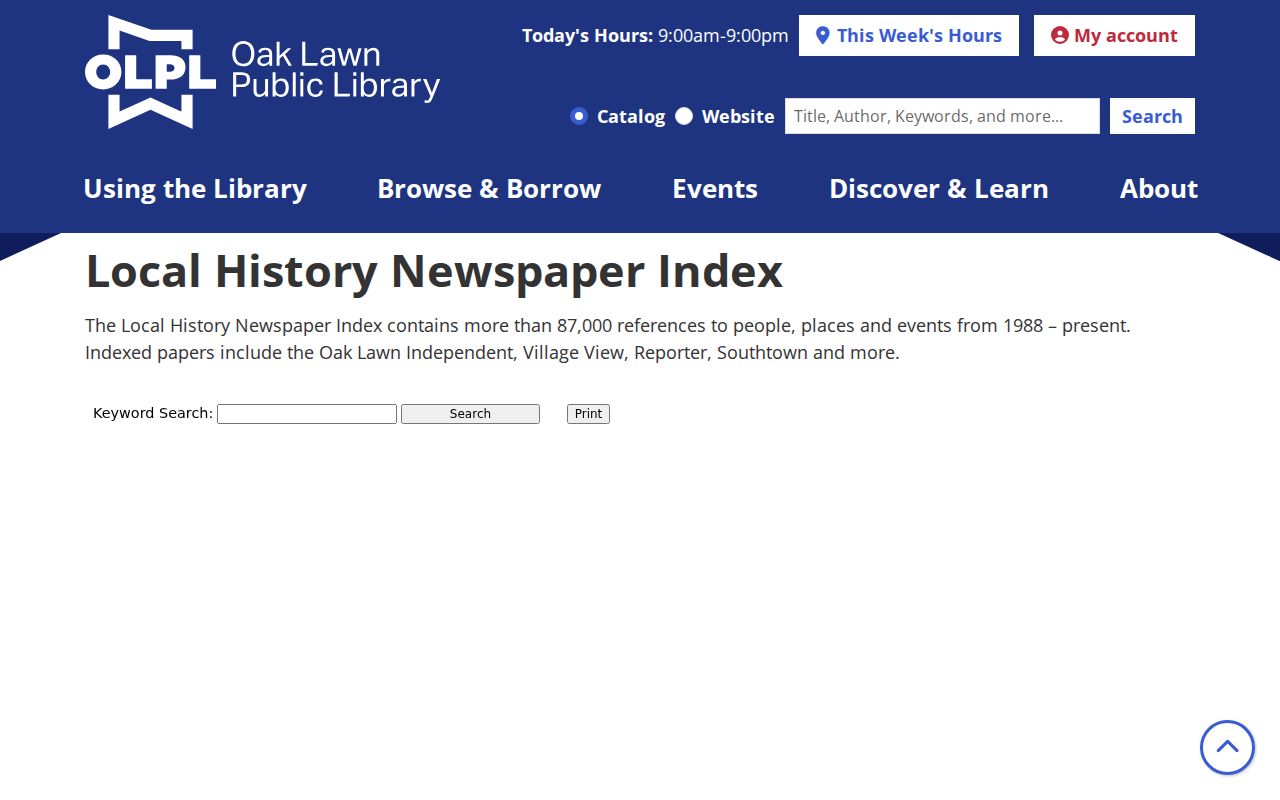
The index screen provides the bridge from a person or event to a source issue. Save that citation before moving to microfilm or asking staff for help.
Trace Oak Lawn Family Years
Family history works best as a sequence of dated snapshots. A directory may show a name and place each year, while the federal census adds household relationships and ages at wider intervals. Under the 72-year release rule, 1950 is the newest generally public decennial census as of 2026. Preserve the township, precinct, or place label printed on the schedule instead of silently converting it to a modern Oak Lawn boundary.
- Normalize the name, street number, direction, suffix, and any older place label. Keep Spring Forest, Black Oaks, and Black Oak Grove as search variants.
- Start with the newest relevant directory or index, then move backward one available edition at a time. Mark a missing row as “not listed.”
- Try initials, spouse names, widow forms, businesses, and cross-streets. Use a criss-cross book when the address is stronger than the surname.
- Pair each directory snapshot with the closest public census schedule. Note that a census captures one date, not the full year.
- Use the OLPL newspaper and obituary references to test a move, death, marriage, or civic link. Record the source and page.
Disappearance alone proves little. The person may have moved, died, changed a name, lived outside the publisher’s area, or simply gone unlisted. The next dated record should decide among those paths.
Oak Lawn Directory Timeline
The surviving research has firm checkpoints but no complete publication chain. A short timeline keeps those different sources from being flattened into a false claim that all Oak Lawn names are online from one start date.
| Year or span | Documented Oak Lawn directory milestone |
|---|---|
| 1923 | The digitized Chicago directory includes Oak Lawn in its suburb guide and geographic introduction. |
| 1928-1929 | The Summit-Argo and Clearing inventory expressly includes Oak Lawn, Spring Forest, and Justice. |
| 1933-2014 | OLPL describes digitized Oak Lawn Independent and Village View microfilm. |
| 1953 and 1955 | Newberry lists Chicago criss-cross volumes for reverse address research. |
| 1985 forward | The OLPL obituary index supplies modern death-notice references. |
| 1988 forward | The OLPL newspaper index supplies modern name, place, and event references. |
| 2006 | OLPL became the official Village repository and received Historical Society material. |
For modern address-keyed research, move to the Oak Lawn street directory workflow rather than stretching historical books beyond their dates. The city directory shelf remains strongest for genealogy, old neighborhood context, and reconnecting through dated school or civic records.